
Term insurance covers death. But real life throws more at you: cancer diagnoses, accidents that leave you disabled, periods where you can’t work or pay premiums. A base term policy doesn’t address any of that. Riders do. These optional add-ons attach to your base policy and cover specific risks at a fraction of what standalone insurance would cost. This article explains what each rider does, what it costs, which ones matter at different life stages, and how to avoid the common mistakes.
Cheat sheet
- Riders are optional add-ons to your term policy that cover risks beyond death: critical illness, accidental death, disability, premium waiver, and terminal illness.
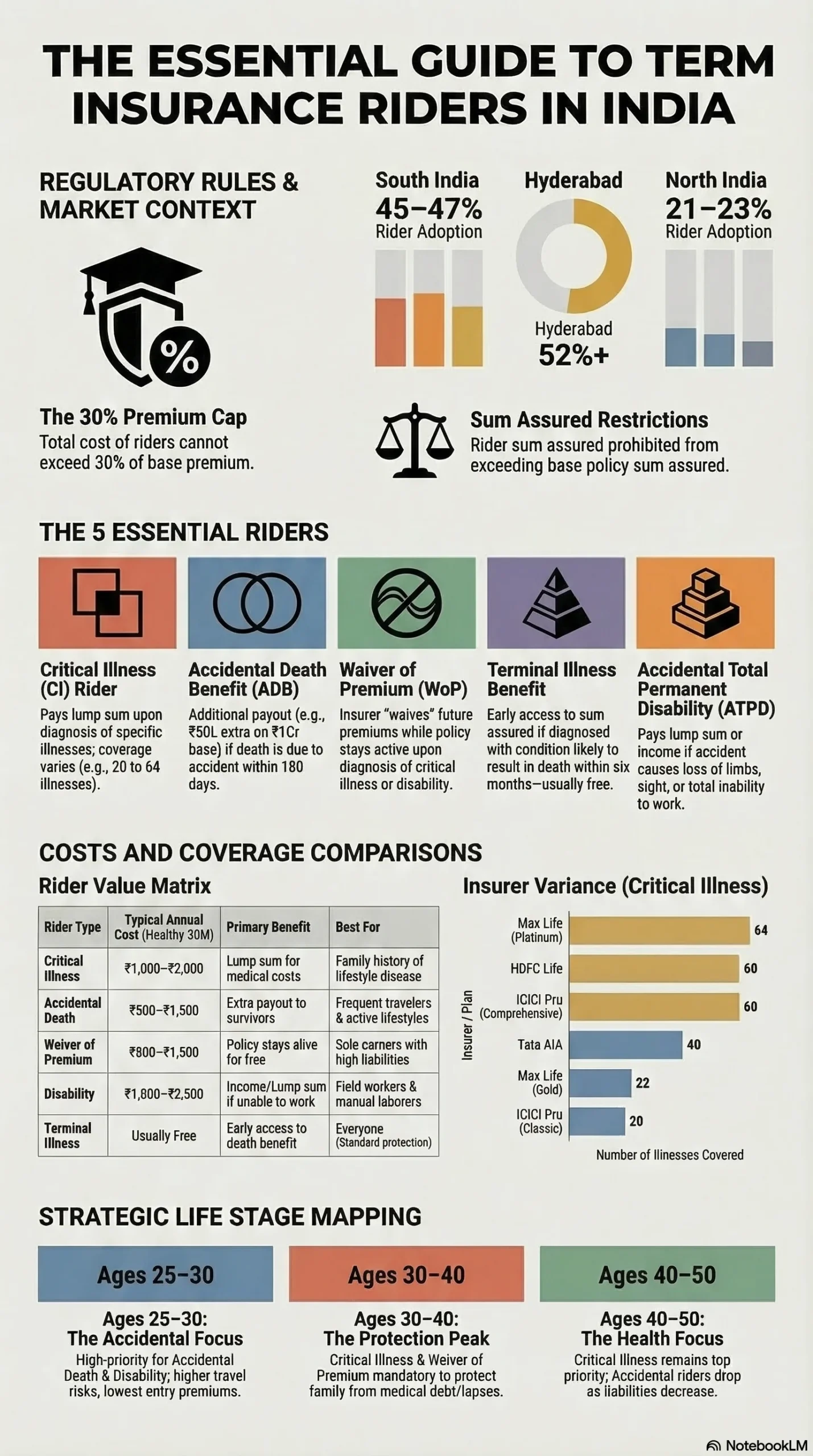
- IRDAI caps total rider premiums at 30% of the base premium for most life insurance plans. Rider sum assured cannot exceed the base sum assured.
- In India, about 25-35% of term buyers add riders, with south India leading at 45-47% adoption. Waiver of premium adoption jumped 42.5% between July and October 2025.
- Critical illness rider coverage varies wildly: Max Life covers up to 64 illnesses, HDFC Life covers 60, Tata AIA covers 40, ICICI Prudential covers 20-60 depending on variant. Same label, very different products.
- Terminal illness benefit is usually free. Most major insurers include it in the base plan at no extra cost. Don’t pay extra for what’s already included.
What riders are and why they exist
A rider is a supplementary benefit bolted onto your base term plan. You pay a small extra premium, and in return you get protection against a specific risk that the base policy doesn’t cover. All riders sit within a single policy document, which is more convenient than managing two or three separate policies for different risks.
The concept is simple: a ₹1 crore term policy pays your family ₹1 crore if you die. But what if you’re diagnosed with cancer and need ₹30 lakh for treatment while you’re still alive? Or what if an accident leaves you permanently disabled and you can’t pay premiums anymore? The base policy does nothing in either scenario. Riders fill those gaps.
Individual death claims paid across the industry
FY 2024-25
+3% from 9,82,615 in FY 2023-24
Total individual death claim payouts
FY 2024-25
Up from ₹28,868 crore in FY 2023-24
Source: IRDAI Annual Report 2024-25
The six riders you’ll encounter
Critical illness rider
Pays a lump sum when you’re diagnosed with a covered illness (cancer, heart attack, stroke, kidney failure, major organ transplant, coronary bypass surgery, among others). The payout is separate from the death benefit, meaning your family can claim both if needed.
The number of covered illnesses varies dramatically between insurers:
| Insurer / Plan | Critical illnesses covered |
|---|---|
| Axis Max Life (Platinum variant) | 64 |
| HDFC Life Click 2 Protect Supreme | 60 |
| ICICI Prudential iProtect Smart (Comprehensive) | 60 |
| ICICI Prudential iProtect Smart (Classic) | 20 |
| Tata AIA Sampoorna Raksha Supreme | 40 |
| Axis Max Life (Gold variant) | 22 |
| SBI Life eShield Next | CI rider not available (CI coverage via separate Poorna Suraksha plan: 36 illnesses) |
Typical annual cost: ₹1,000 to ₹2,000 for a 30-year-old with ₹50 lakh CI cover. The definitions matter as much as the count. A CI rider that “covers 60 illnesses” is only useful if the policy definitions match real-world diagnoses. More on this in our article on how riders affect claim settlement.
Watch Out: A critical illness rider covering 60 illnesses is only useful if the policy definitions match how doctors actually diagnose them. Read the policy wording, not the brochure.
Is a critical illness rider worth the cost?
That depends on your existing health insurance and your family’s medical history. A CI rider pays a lump sum the moment you’re diagnosed; you can use it for anything, not just hospital bills. This matters because a serious diagnosis involves more than hospitalisation: lost income during 6-12 months of treatment, out-of-network medications, travel for specialist consultations, and home care during recovery. Your health insurance policy doesn’t cover any of that.
The economics: a CI rider covering ₹25 lakh costs roughly ₹1,000-1,500 per year at age 30. A standalone critical illness policy for the same cover costs ₹3,000-5,000 per year. The rider is cheaper because it piggybacks on your term plan’s existing underwriting. The trade-off is that riders typically cover fewer conditions and use narrower definitions than standalone policies.
Add the CI rider if you have a family history of cancer or heart disease, your health insurance cover is below ₹10 lakh, or you’re the sole earner with no emergency fund beyond 6 months of expenses. Skip it if you already have a standalone CI policy with adequate cover, or your employer provides group health insurance that includes CI benefits.
Accidental death benefit (ADB) rider
Pays an additional sum assured on top of the base death benefit if death occurs due to an accident. If your base cover is ₹1 crore and your ADB rider is ₹50 lakh, your family receives ₹1.5 crore on accidental death, and ₹1 crore on death from illness or natural causes.
LIC’s ADB rider costs ₹1 per ₹1,000 of rider sum assured per year (₹100 per ₹1 lakh per year). For ₹50 lakh ADB cover, that’s ₹5,000 per year. Other insurers charge similarly.
Standard exclusions: death while under the influence of alcohol or drugs, participation in hazardous sports (skydiving, motor racing, bungee jumping), criminal activity, suicide, and war. Death must occur within 180 days of the accident to qualify. Maximum rider sum assured is typically capped at the base sum assured.
When does the ADB rider make sense?
The ADB rider is worth adding if your family’s financial exposure is highest during your earning years and you face above-average accident risk from daily commuting, frequent travel, or a physically demanding occupation. At ₹100 per ₹1 lakh per year (LIC’s rate), ₹50 lakh ADB cover costs ₹5,000 annually — modest for an additional ₹50 lakh payout on accidental death.
It matters less if your base term cover is already adequate regardless of cause of death. A ₹2 crore term plan pays ₹2 crore whether you die from illness or accident. The ADB rider only adds value if your family needs the extra payout specifically in the accident scenario — for instance, if accidental death would also mean losing employer-provided housing or education benefits that the base term payout needs to replace.
One often-overlooked limitation: the ADB rider does not cover death from complications that develop after an accident (such as post-surgical infections weeks later, in some policy wordings). The death must be directly caused by the accident and occur within the specified window (typically 180 days).
Waiver of premium rider
Waives all future premiums if you become permanently disabled or are diagnosed with a critical illness. The base policy continues at full value without you paying another rupee. This rider costs ₹1,000 to ₹5,000 per year (under 20% of the base premium). Bajaj Allianz’s eTouch II includes it free.
The trigger conditions vary by insurer. Some cover only accidental disability. Others cover disability from any cause plus critical illness. This is a meaningful difference. Read our detailed waiver of premium guide for the full comparison.
Income benefit rider
Instead of a single lump sum, the death benefit is paid as a monthly income to the nominee for a fixed period (usually 10 years). ICICI Prudential’s income benefit option pays 10% of the sum assured every year for 10 years in equal monthly instalments. For ₹1 crore cover, that’s ₹83,333 per month for 10 years.
This structure suits families that would struggle to manage a large lump sum and prefer a steady income stream to replace the breadwinner’s salary. It also reduces the risk of the lump sum being mismanaged or depleted too quickly.
Permanent/total disability rider
Pays a lump sum or periodic income if you suffer permanent total disability from an accident. The disability must be total and permanent (loss of both limbs, both eyes, or complete inability to perform any occupation). Partial or temporary disability does not qualify. Costs ₹1,000 to ₹2,500 per year depending on coverage amount and insurer.
Terminal illness rider
Provides early access to the sum assured when diagnosed with a condition likely to cause death within six months. Here’s what most buyers don’t know: this benefit is usually included free in the base term plan. You don’t need to pay extra for it.
Did You Know: Most major insurers include terminal illness benefit in the base term plan at no extra charge. Check your existing policy before paying for it as a separate rider.
| Insurer | Terminal illness payout | Cost |
|---|---|---|
| ICICI Prudential | 100% of base sum assured | Built-in (free) |
| HDFC Life | Up to ₹2 crore (capped) | Built-in (free) |
| Bajaj Allianz | Up to ₹2 crore (capped) | Built-in (free) |
| Axis Max Life | Up to ₹1 crore (capped) | Built-in (free) |
| Tata AIA | Up to 50% of base sum assured | Built-in (free) |
| SBI Life | Built-in | Built-in (free) |
Two doctors must confirm the diagnosis: your treating physician and a specialist from the insurer’s panel.
IRDAI rules on riders
IRDAI places three constraints on riders. Total rider premiums across all riders cannot exceed 30% of the base plan premium. The rider sum assured cannot exceed the sum assured of the base policy. And the rider term cannot exceed the base policy term. Once fixed, the rider premium stays constant for the entire policy tenure.
Key Fact: IRDAI caps total rider premiums at 30% of the base plan premium, and the rider sum assured cannot exceed the base policy’s sum assured.
IRDAI DATA
Source: IRDAI Annual Report 2024-25
These caps exist to prevent insurers from loading riders to the point where the “term plan” is really a bundled product in disguise.
“Critical illness and waiver of premium riders usually add real value, especially for earning members. They provide support during serious health events when income may stop. Accidental riders can help too, but not everyone needs every rider. I prefer recommending them only if they align with the client’s risk profile and financial situation.”
— Mit Haria, Founder, Haria and Associates
Which riders matter at which life stage
Age 25-30, single, early career
Accidental death/disability is the highest priority rider at this stage. Younger adults face proportionally higher accident risk from commuting and travel, and the rider costs are lowest at this age. Waiver of premium is worth adding because if disability strikes now, you have 30+ years of premiums ahead. Critical illness is lower priority unless you have a family history of cancer or heart disease, but the premiums are cheapest now if you choose to add it.
Age 30-40, married with children
This is the life stage where riders matter most. Critical illness becomes the top priority because medical costs can wipe out a young family’s finances, and heart disease and cancer risk starts to climb. Waiver of premium is a must-have because your family cannot afford a policy lapse while you’re disabled. Income benefit rider is highly relevant because a monthly payout replaces the breadwinner’s salary and helps the family meet EMIs and school fees. Accidental death stays important as an additional coverage layer.
Age 40-50, established
Critical illness becomes the single most important rider as cancer and cardiac risk rises sharply. Waiver of premium remains relevant though the rider tenure is shorter. Accidental death drops in priority as financial obligations start reducing (children growing up, loans nearing closure). Verify that your terminal illness benefit cap still covers your current needs.
How much riders really cost
| Rider type | Benefit | Typical annual cost* | Best for |
|---|---|---|---|
| Critical illness | Lump sum on diagnosis of listed illnesses | ₹1,000 to ₹2,000 | Family history of lifestyle diseases |
| Accidental death benefit | Extra payout on accidental death | ₹500 to ₹1,500 | Frequent travellers, physically active |
| Waiver of premium | Premiums waived on CI or disability | ₹800 to ₹1,500 | Sole earners with liabilities |
| Income benefit | Payout in monthly instalments after death | ₹1,200 to ₹2,000 | Families needing steady income replacement |
| Disability | Payout for permanent total disability | ₹1,000 to ₹2,500 | Manual workers, drivers, field workers |
| Terminal illness | Early payout on terminal diagnosis | Usually free (built-in) | Everyone (verify it’s included) |
*Indicative ranges for a healthy 30-year-old male; actual cost depends on age, health, insurer, and coverage amount.
Rider adoption in India: the 2025 picture
According to Policybazaar’s November 2025 Term Insurance Report, rider adoption varies sharply by region. South India leads with 45-47% of term buyers adding riders (Hyderabad tops individual cities at 52-56%). North India lags at 21-23%.
By rider type: ATPD (accidental total permanent disability) has the highest attachment rate at 21.4% nationally. Waiver of premium sits at 6.7% but grew 42.5% between July and October 2025. Critical illness adoption in top metros ranges from 7% (Mumbai) to 13% (Hyderabad).
Did You Know: Waiver of premium rider adoption grew 42.5% between July and October 2025, suggesting more buyers are waking up to the risk of losing their cover while disabled and unable to pay premiums.
Men adopt riders at a slightly higher rate (30.3% vs 25.8% for women), but women increasingly prefer critical illness riders, particularly cancer-focused coverage. NRI buyers attach ATPD riders at 42.1%, nearly double the domestic rate.
| Year | Claims paid | CSR (by count) | CSR (by amount) |
|---|---|---|---|
| FY 2024-25 | 10,11,880 | 98.32% | 97.18% |
| FY 2023-24 | 9,82,615 | 98.36% | 97.00% |
| FY 2022-23 | 10,60,419 | 98.59% | 96.46% |
| FY 2021-22 | 15,87,110 | 98.97% | 97.26% |
| FY 2020-21 | 10,83,623 | 98.85% | 96.62% |
Source: IRDAI Annual Reports, 2020-21 to 2024-25. FY 2021-22 spike reflects COVID-era claims.
Case study: how a ₹1,500 rider saved Anand’s family
Anand, 30, bought a ₹2 crore term plan with a ₹50 lakh critical illness rider for an additional ₹1,500 per year. In late 2025, he was diagnosed with early-stage cancer requiring ₹12 lakh in treatment. The CI rider paid ₹50 lakh as a lump sum. Anand used ₹12 lakh for treatment and put the rest into a fixed deposit to cover household expenses during his six-month recovery.
The rider cost him ₹1,500 per year over five years (₹7,500 total). The payout was ₹50 lakh. His base term cover remained fully intact throughout, meaning his family’s ₹2 crore death benefit was never touched.
Five mistakes to avoid when choosing riders
- Adding every rider available. More riders means more premium. Choose based on your specific risks, not because the option exists. Two well-chosen riders beat five unnecessary ones.
- Not reading the policy definitions. A “critical illness rider covering 40 illnesses” is meaningless if the definitions are so narrow that most real-world diagnoses don’t qualify. Read the policy wording, not the brochure.
- Ignoring the terminal illness benefit. Check whether it’s already built into your base plan before paying extra for it. Most major insurers include it free.
- Skipping the waiver of premium. At ₹800-1,500 per year, this rider protects you from the worst possible scenario: losing your income and your life insurance at the same time.
- Assuming all CI riders are equal. Max Life’s Platinum variant covers 64 conditions. Their Gold variant covers 22. Same insurer, same plan, dramatically different products. Check the variant you’re buying.
Tax treatment
Accidental death and waiver of premium rider premiums typically qualify under Section 80C as part of the total life insurance premium (up to ₹1.5 lakh aggregate limit). Critical illness rider premiums may qualify separately under Section 80D (the health insurance deduction). Both deductions are available only under the old tax regime. Confirm with your insurer or tax advisor, as classification varies by product.
Quick Tip: If you’re on the old tax regime, ask your insurer to split the CI rider premium on your premium receipt; it may be deductible under Section 80D, separate from your 80C limit.
“Buyers must be highly discerning when it comes to adding riders, which act like expensive pizza toppings. I generally advise against buying critical illness riders bundled inside a term plan; if you have a robust independent health insurance portfolio, the bundled rider offers limited utility and operates under rigid parameters. Similarly, standard accidental disability riders often feature strict, fine-print definitions that only pay out under narrow definitions of immediate accident-driven trauma. Instead, buying an independent, comprehensive Personal Accident Policy is far more effective, as it covers permanent total, temporary, and partial disabilities under transparent terms. The one rider genuinely worth adding is the Waiver of Premium rider. If the policyholder suffers a severe disability that impairs their earning capacity, this feature kicks in to waive all future premiums while keeping the core life insurance policy fully active.”
— Vinit Iyer, CFA, CFP, Chartered Wealth Manager
Frequently asked questions
Can I add riders after buying a term plan?
Usually not. Most insurers require riders to be selected at the time of buying the policy. Axis Max Life is an exception, allowing their waiver of premium rider to be added later. If you’re unsure, add it now; you probably can’t go back.
Can riders be removed mid-policy?
This depends on the insurer. Some allow removal at renewal; others (like Tata AIA’s waiver of premium) explicitly state the rider cannot be deleted after inclusion.
Are riders always beneficial?
Not automatically. A critical illness rider with a ₹10 lakh sum assured is redundant if you already have a ₹20 lakh health insurance policy covering the same conditions. Evaluate each rider against your existing coverage.
What if I have a pre-existing condition?
Some riders may be denied or rated up during underwriting. Critical illness riders are sometimes removed from the offer even when the base policy is approved. If you have a pre-existing condition, read our guide on getting term insurance with pre-existing conditions.
What is the IRDAI cap on rider premiums?
Total rider premiums cannot exceed 30% of the base plan premium. Rider sum assured cannot exceed the base sum assured. Rider term cannot exceed the base policy term.
Should I buy riders or separate insurance policies?
For critical illness, a standalone policy often provides broader coverage and higher limits. For accidental death, the rider is convenient and usually cheaper than a standalone personal accident policy. For waiver of premium, a rider is the only option (no standalone product exists). For terminal illness, check whether your base plan already includes it free.